Sunday, 17 March 2013

Belfast Derivé

I've started doing a bit of situationist style 'drifting,' or 'derivé,' around Belfast. It's initially so I can get to know some unexplored areas of the city and revisit some places I haven't been in a long time. I'm trying to video each of the walk (by means of a subtly hidden camera in my lapel pocket to allow me to enjoy the dander, and avoid strange looks from people). I'll be adding these to the map as and when I can get them edited and uploaded to YouTube. One or two are already added, just click the lines on the map below to view them.

Enjoy!


View Derive in a larger map

Thursday, 7 February 2013

To Belfast - A short film about a city

Another video blog entry, a set of maps detailing the development of Belfast set to some music and poetry which illustrates my bitter-sweet relationship with the city along with the difficulty of maps for representation.


Music - 'Going to Your Funeral prt2' by The Eels, taken from the album 'Electro-Shock Blues'

Words - 'To Belfast' by Alan Gillis, taken from the book 'Somebody, Somewhere.' Please see previous 
 post (http://passoverinsilence.blogspot.com/2013/01/for-belfast-alan-gillis_24.html) for  words.

Sources - 
Bardon, J. & Bell, H.V. (1982) Belfast :an illustrated history. Repr with corrections edn, Dundonald: Blackstaff Press.
Bardon, J. & Conlin, S. (1985) Belfast: 1000 years. Belfast: Blackstaff.
Gillespie, R. & Royle, S.A. (2006) Belfast C.1600 to 1900 :the making of the modern city. Dublin: Royal Irish Academy.
Patton, M. & Ulster Architectural Heritage Society (1993) Central Belfast: an historical gazetteer. Belfast: Ulster Architectural Heritage Society.
Royle, S.A. (2007) Belfast, 1840 to 1900. Dublin: Royal Irish Academy.

Wednesday, 30 January 2013

Forgetting Belfast


This was originally published in the December 2012 issue of 'The Ulster Folk.' This is a highly edited version of a previous blog post, found here.

Northern Ireland is booming. ‘Our time, our place’ screams the slogan from every billboard, television and radio, not only across the province but also the UK and Ireland (a Dubliner recently told me he’s sick of hearing it). My question is who exactly is the ‘us’ of this slogan. Who’s time? Who’s place? The motivation behind redevelopments such as Victoria Square and Titanic Quarter along with future proposals such as Royal Exchange and the new University of Ulster appears to be either tourism or big business, the citizens of Belfast apparently not taken into account.

Belfast has never fully recovered from the conflict, still reading as a cultural waste-ground, and the current bout of redevelopment and investment doesn’t seem to be helping. But how did Belfast become a cultural void; forty years of ‘The Troubles’? A cursory look at the history of planning decisions in Belfast reveals it hasn’t all been caused by terrorism.

In the early 1960s Belfast was experiencing significant growth leading to a strained transport network. The Belfast Corporation developed a series of large-scale planning proposals including a massive urban motorway encircling the city core and a new urban masterplan. The timing of these plans corresponded with the beginning of ‘The Troubles,’ the explosion of violence resulting in a sharp decline in Belfast’s population and essentially rendering the proposals irrelevant.

Thanks to ongoing resistance from residents coupled with the escalation of violence the majority of these plans were shelved. However, a significant amount of the ‘slum clearance’ went ahead, as did phase one of the motorway; albeit in the altered sunken version of ‘The Westlink.’ These measures were enough to significantly blight inner north and west Belfast to this day, which a suspicious person may suggest was the intention of the plans in the first place in order to fragment these ‘troublesome communities.’

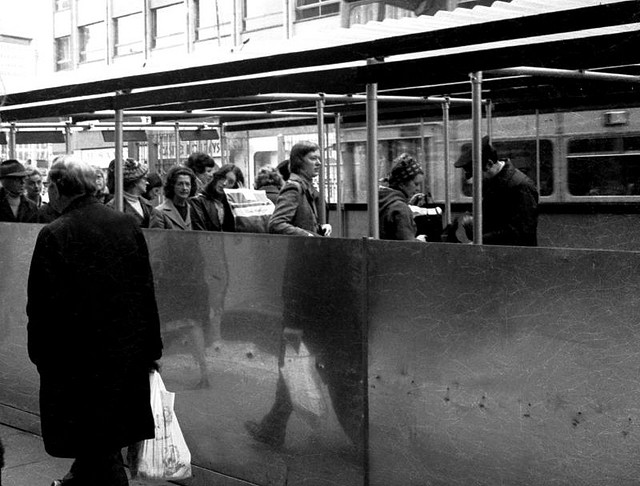
At the same time, due to co-ordinated paramilitary violence against businesses in the city, the infamous ‘ring of steel’ began to take shape around the city core. Beginning with informal military checkpoints on major routes, security measures intensified over the 1980s to the point where citizens who wanted to access central Belfast were made to queue up to pass through turnstyles in ten foot high steel walls, only being granted access once they had been frisked by military personnel. This led to a negation of ownership with regards to the city. The city centre was owned by someone else, be they military or paramilitary.
This removal of people from the city centre has created the cultural vacuum that is Belfast city centre today. The physical conflict has gradually died out since the ceasefires of the early 1990s, causing politicians to hail the success of the ‘peace process.’ The neutrality of the city centre, sterilised so as not to scare off investors, along with the segregation of inner city neighborhoods suggests that the conflict is far from gone.

In Belfast we are proud of our past, particularly with regards to shipbuilding and linen, yet the city centre is totally devoid of any official memorials or markers for the appalling atrocities committed in the past forty years. Oxford Street bus station, a building that became synonymous with ‘Bloody Friday,’ has been scoured from the street and replaced with an office complex. The gruesome descriptions from eyewitnesses on the ground that day are comparable to reports coming out of Kosovo and Syria in recent years. Yet this traumatic event goes unmarked, consisting only of individual memory and official documents.
A culturally empty urban centre is but a small problem, however, when we consider the memorials and plaques outside the city centre; each community choosing to memorialise specific events within their own areas. This causes misremembered and editorialised versions of these events to be passed down the generations, reinforcing the ‘us and them’ tradition. Local urban geographer Peter Shirlow describes this as “The criminilisation of the ‘other’ community and the failure to recognise suffering was endured within both communities...”

What we need is a meaningfully cultural city centre that goes beyond gaudy tourist attractions, glass shopping centres and the halcyon days of linen and shipbuilding and begins to speak of what we’ve been through, confronting us with how awful it was in our day to day civic engagements. This will enable us to move forwards and mark off how far we’ve come.

More than this, it will allow us to reclaim the city before someone else does.

Monday, 28 January 2013

Laganside - Belfast Sonic Poetry App

This article was published initially on the PLACE blog and then in the December 2012 edition of 'The Ulster Folk.'
It seems all too easy to criticise Belfast’s tired looking Langanside development, perhaps this is because it’s all too easy to forget how bad the post-industrial wasteland the banks of the Lagan were in the late eighties. It’s also easy to forget how incredible the aspirations of the Laganside Corporation were, given that it formed almost a decade before the Good Friday Agreement.

A new smartphone app called ‘Laganside’ highlights this dichotomy, enabling users to engage with this at times forsaken area; an area where Belfast’s aspirations, past, present and future, are made flesh. Developed by PhD music student John D’Arcy, the app was  launched on Culture Night 2012.

Taking on and surpassing the recent sonic arts trend in “digitised relational maps using embedded media,” ‘Laganside’ makes use of the contemporary epic poem of the same name, with a great reading by voice over artist Patrick FitzSymons. D’Arcy explains the reasons for choosing this particular piece by Belfast poet Alan Gillis. “Laganside doesn’t name particular places, but you know where he’s talking about, or you think you know and make your own connections based on your experience of Belfast, your personal history of it.” The app makes the academic fields of the sonic arts and poetry immediate and accessible, allowing the user to bridge the gap between the text and the space to which it refers.

The app’s unique design, by visual artist Gerard Carson, makes use of the smart phone’s ‘geo-location’ ability to track the user’s position along a three mile walk hugging the river. As the user approaches specific areas ‘soundscapes’ are triggered. A flurry of distorted music, sound effects and barely audible voices heightens the experience and lends further weight to both poem and locale. “The poem remains the same,” John explains, “but depending on your location your experience of it differs.” There are a number of other poems which can only be ‘collected’ by visiting locations along the route, something which should lend the app longevity, and perhaps suggesting that further routes could be added in the future.

The first soundscape I experienced was located at a platform jutting out into the river immediately behind the Waterfront Hall. As I ascended the short ramp to the platform a frenzy of noise overwhelmed me and the previously jovial voice in my ear took on a sinister air. I stood overlooking the river; several seagulls lined up along the steel balustrade eyed me resentfully before one by one taking off toward the lough; a train glided gently over the water; the city loomed behind. I felt consumed by sound, the  rhythm of the verse and my environment.

The meandering cadence of the poem, which describes a man’s walk along the regenerated riverfront with his ‘better half,’ gradually builds towards an understated yet profound climax. “Leaving me to find our way back to the streets, knowing I’ll never leave here, or come back again.” Fighting back the lump in my throat, the words resonated so strongly. From the grit and filth of the late eighties Belfast has surpassed itself, moving so fast the city is at times hard to recognise. The Laganside area is the embodiment of Belfast’s decline and regeneration; a city which never fails to impress and disappoint in equal measure.

‘Laganside - Belfast Sonic Poetry App’ is available for free on iTunes for iOS and Google Play for Android. Visit http://lagansideapp.com for information on the app or http://johndarcy.co.uk/ for other projects by John D'Arcy.

Friday, 25 January 2013

Critical Writing Part 2 of 2 - Belfast of New

The following was written as part of a critical writing workshop held at PLACE, run by art and architecture critic Marianne O'Kane Boal. This is a critical article on the new MAC theatre, meant as a companion piece to a critique of St George's Church, found here.

I remember watching the MAC being constructed from the architecture studio of the neighbouring University of Ulster. I distinctly recall the surface of my black coffee shimmering as the building’s piles were driven down into the sleech upon which most of central Belfast rests. I later remember observing the jutting cast concrete forms and, comparing them to the drawings and renders of the building, thinking ‘too complicated, too much going on, too busy.’ In retrospect I see I was becoming ‘Architect,’ and ‘Architect’ could always do better, ‘Architect’ is always cynical.

Now the MAC is open I am a regular visitor; be it for coffee with friends, visiting an exhibition in the galleries or informal tutorials and meetings as part of my research. It’s a building I make use of regularly, all of my initial reservations being erased by the elemental act of utility. In mid January 2013 I was lucky enough to be part of a group to receive a guided tour of the building by project-architect and associate of Hall McKnight (previously Hackett & Hall) architects Nigel Murray. This gave me opportunity to sort through my contradicting thoughts.

The new MAC (Metropolitan Arts Centre) replaces an older Georgian building referred to as the OMAC (Old Museum Arts Centre), updating the slightly beleaguered building while significantly expanding the theatre’s capacity as well as relocating to the Cathedral Quarter; Belfast’s greatest hope for a vibrant, bohemian district. The building’s brief fills a definite gap in the city, providing an alternative theatre space to the formality of the Grand Opera House, acting as a companion piece both architecturally and programmatically to affluent South Belfast’s Lyric theatre in not-so-affluent North Belfast.

The MAC is a hopeful building.

The theatre/galley, which completes the fourth edge of the much derided St Anne’s Square, has two entrances. The red brick mass which faces the university (in anticipation of a future adjoining development) wraps round the corner and steps back at a right-angle, inviting pedestrians of Exchange Street into the building. Facing St Anne’s Square, a black basalt mass gives way to a sliding glass door, enhancing rather than shaming the previously odd and uncomfortable plastic classicism of the plaza. Both entrances lead to a broad public concourse, providing an alternative, and arguably preferable, route through the square.

The MAC is a public building.

The building is comprised of three forms; the imposing block of the main theatre and ‘Upper Gallery,’ the floating wedge of the smaller theatre and ‘Tall Gallery,’ and the residual space caught between the two which forms the public concourse. It was this third space which concerned me the most when gazing out from the University or pouring over the drawings and images made available online. The space seemed too awkward, the angles too severe; a space already complicated by the difficult site further abstracted by the positioning of the two hulking forms. Ironically, this is the part of the building that, for me, works the best. The vaulting brick piers and long, high windows lend a vaguely religious aspect to the building. The subtle material changes, from bare concrete, slick terrazzo, warm wood of an almost burnt hue, suggest but don’t prescribe journeys and activities. The seating areas feel like intimate retreats from the bustle and business of the cafe and box office; a range of booths allowing you to step away for a moment while the low ceiling height of the open-seating area offers a sense of enclosure.

The MAC is an intimate building.

As we wind our way upwards, the obtuse angles become quite disorientating. We walk up the main stair, across a landing overlooking the bar and up a more intimate set of steps and for a moment I feel lost. This feeling, however, is never unpleasant. As our journey ribbons through the building the building wraps around us. We enter the tall gallery and all feeling of disorientation is exploded as we are confronted with a huge picture window. Where another designer would have centered this window on the squat yet majestic bulk of St Anne’s Cathedral, Hackett & Hall invite us to look beyond it. The church features on the periphery of a magnificent view of the city itself.

The MAC is a civic building.

The rest of our tour reinforces these initial impressions. Stepping out from the dark warmth of the main 350 seat theatre, a large window reconnects you with the square. Ascending the stair you note the feeling of warm leather under your palm, enclosing the industrial handrails. The confusing warren of corridors connecting the teaching spaces, offices and dance studios are relieved by occasional, sometimes tantalising views of the city or neighbouring buildings. These dichotomies, public - private, warm - cold, light - dark, lost - found, all brought forth by the difficult site and complicated brief, are reconciled harmoniously within this envelope; achieved by the delicate balance of spatial requirements, careful consideration of thresholds and impeccable detailing.

The MAC is a complex building.

Critical Writing Part 1 of 2 - Belfast of Old

The following was written as part of a critical writing workshop held at PLACE, run by art and architecture critic Marianne O'Kane Boal. This is a critical article on the listed St Georges Church, meant as a companion piece to a critique of the MAC, found here.

Sometimes I get a peculiar feeling when I walk down High Street. I imagine the Farset bubbling away beneath my feet from it’s source high up in the Black Mountain, now demeaned to flowing through a sewer pipe to join the Lagan. I imagine the broad avenue as it would have been; a dirt track running along the south bank of the stream connecting the motte and bailey of Belfast’s original castle and the ‘Chapel of the Ford’ situated at the sandbank formed by the confluence of the Farset, the Blackstaff and the Lagan, giving Belfast it’s name.
Map of Belfast in 1300 (showing Castle and Chapel)
compared with 2008 map
The peculiar feeling intensifies standing in front of St Georges Church at the top of High Street, at what would have been the site of the original Chapel. The city of Belfast is around four hundred years old; there has been a place of worship on this site for over seven hundred.

The original building was demolished in the late 18th century after a checkered and colourful history, from becoming the choice of church for town officials to being used as a Cromwellian stockade, and the current building’s foundation stone was laid in the early 19th century when the newly constructed St Anne’s church was deemed too small. Despite this lively past, the church itself is a tranquil oasis from the traffic-heavy junction of High Street and Victoria Street. Set back from the road, I would assume the building goes largely unnoticed most pedestrians (and certainly motorists). The church is designed in the classical style popular in the early 19th century and was originally intended to be a simple rectangular plan with a slightly curved facade at the entrance, perhaps looking similar to the First Presbyterian Church in Rosemary Street. However, the entrance was further enhanced by the introduction of the portico, acquired from the house of the Bishop of Derry, in Ballyscullion, after the Bishop’s death. This lends the building a much more grandiose air, an imposing and proud presence on Belfast’s oldest thoroughfare.

Stepping through the front door, the visitor finds themselves in an octagonal porch full of the periphery of worship, stacks of hymnals, prayer cushions, boxes of candles, etc; reminding the architectural tourist that this is still an operating Anglican church. Flanked on either side by winding staircases leading to the gallery the porch also acts as a final threshold between the city and the sanctuary of the nave. Stepping through the double doors into the space of worship beyond is a significant act. ‘The silence is deafening,’ goes the cliche. The total absence of the incessant sounds of urbanity is at first disconcerting.

As I walked up the centre of the nave my footsteps felt incredibly conspicuous. I settled into one of the timber pews and allowed myself to relax. Only then could I begin to observe the interior without that feeling unease. The nave itself a simple rectangular plan surrounded by squat, round-headed stained glass windows. A U-shaped gallery, supported on columns with ornate composite corinthian heads painted gold. Tall upper windows left unstained allowing bright natural light to flood the space, also allowing glimpses of sky (and the occasion modern apartment block). The room is lined with timber pews, all pointing toward a grand, and rather fussy, chancel.

The Victorian chancel almost stands in direct opposition to the clean, classical Georgian nave, almost demanding your attention. Adorned with paintings dating from the early 19th and 20th centuries and paying host to a grand pipe organ, the space is dominated by a full height stained glass window, enhancing the exuberant decoration and giving everything a slightly ethereal glow. This makes the space seem like an add-on to the simplicity of the
nave and the styles seem to clash nosily, once the urban visitor's ears have got use to the silence.

Walking around the nave, the engaged visitor will once again be put in direct contact with the very roots of Belfast as a city. A number of memorial plaques flank the chancel, the newest dating from 1938, the oldest being 1856. This oldest plaque is a memorial to Sir Henry Pottinger, who’s family played a prominent role in the establishment and development of the city of Belfast. Again, walking in the churchyard and examining the scattering of headstones, one gets an acute sense of the church’s embedded nature in the history of Belfast. While all relatively new when compared with the church building itself, the earliest one I could see was dated 1968. This year will resonate with a few as the year the idea of the ‘Westlink’ was conceived, and many others as they year the most recent incarnation of ‘The Troubles’ began; two events which have fundamentally defined the contemporary city of Belfast.

Despite it’s hotchpotch nature, an inevitability given the age of the building, St George’s Church is not only an important piece of architecture but is firmly embedded in the urban history of Belfast. It’s history is Belfast’s history, something which sends a chill down this otherwise level-headed architect’s spine.

Thursday, 24 January 2013

To Belfast - Alan Gillis


I happened across the following poem which sails scarily close to the application of my theoretical model to the city of Belfast, published in 2004. My entire PhD project summed up in four succinct, profound and distinctly Northern Irish verses.

To Belfast

May your bulletproof knickers drop like rain
and your church-spires attain a higher state of grace.
My lily-of-the-valley, the time is at hand
to ring your bells and uproot your cellulose stem.
I bought hardware, software, and binoculars to trace
your ways of taking the eyes from my head.

And none of it worked. We've been coming to a head
for too long; aircraft prick the veins of your rain-
bow as they shoot you in soft focus to trace
the tramlines of your cellulite skin. But with the grace
of a diva on a crackling screen, you never stem
to their cameras, you're forever getting out of hand.

Once in school, on a greaseproof page, we had to trace
the busts and booms of your body, and I was ashamed to hand
mine in because it lacked what Da called grace.
And I wish I was the centre of a rain-
drop that's falling on your head, the key to your hand-
cuffs, the drug that could re-conjugate your head.

For Belfast, if you'd be a Hollywood film, then I'd be Grace
Kelly on my way to Monaco, to pluck the stem
of a maybell with its rows of empty shells, its head
of one hundred blinded eyes. I would finger your trace
in that other city's face, and bite its free hand
as it fed me, or tried to soothe the stinging of your rain.

Alan Gillis - taken from 'Somebody, Somewhere' (2004)