Showing posts with label Troubles. Show all posts

Friday, 6 December 2013

The City As An Idea - a reflection on what I'm doing

As the end of the year approaches and I plan and contemplate the body of work ahead I've been, understandably, thinking about what I've done and how it should proceed. I now think I can explain my map and my films in a way I could not have done before, even when I was producing them.


For the first time in a while I listened to the song 'Going to your Funeral' by The Eels, the reprise of which I used in my first film 'To Belfast.'


There is a line in the original song which goes 'Look at all the people with the flowers in their hands. They put the flowers on the box that's holding all the sand that was once you.' It struck me that this has a significance to the last film I made, 'Tomb.' 


The film concludes by suggesting that the attitude that Belfast is in some way dead, or even profoundly damaged, is a total misnomer. Belfast is not a living organism and cannot be dead or even injured. We can use the metaphor to describe our opinions in a poetic and engaging way, but when it comes to honestly trying to get the city working we need to remember they are only metaphorical and ultimately not true. So when E quite unromantically remarks that whatever resides in the box at the funeral is indeed not his loved one but rather a pile of 'sand,' this applies even more readily to a city.

A city is what John Searle would call a social construct (in particular an institutional social construct); if it were not for us grouping the set of phenomena relating to this specific space on earth into a subset which we label Belfast, then Belfast would simply not be. Belfast is a set of ideas, be it the approach to the sandbank ford, the strategic gateway to the Ards, the residence of the Chichester family, the incorporated market town, 'boomtown' of Imperial Victoriana, modernist hub of industry and commerce, religious warzone or 21st century tourism and shopping destination. 

As Alan Moore suggested in 'V for Vendetta,' ideas don't die. Ideas ebb and flow, they contradict and adjust. They defy three dimensional space and fly in the face of logic and rationality. Cities, like ideas, are not things or objects, but are dynamic lived processes which refute absolutism and universality. Any perception we have of an idea dying or not being there is just that; a perception. A perception of the passing of a way-of-being we held dear, or at worst reified. As long as we bear in mind that they are simply ideas which suggest a way of living then their departure should not worry us so much.

Cry onwards to the next 'Belfast!'

Wednesday, 30 January 2013

Forgetting Belfast


This was originally published in the December 2012 issue of 'The Ulster Folk.' This is a highly edited version of a previous blog post, found here.

Northern Ireland is booming. ‘Our time, our place’ screams the slogan from every billboard, television and radio, not only across the province but also the UK and Ireland (a Dubliner recently told me he’s sick of hearing it). My question is who exactly is the ‘us’ of this slogan. Who’s time? Who’s place? The motivation behind redevelopments such as Victoria Square and Titanic Quarter along with future proposals such as Royal Exchange and the new University of Ulster appears to be either tourism or big business, the citizens of Belfast apparently not taken into account.

Belfast has never fully recovered from the conflict, still reading as a cultural waste-ground, and the current bout of redevelopment and investment doesn’t seem to be helping. But how did Belfast become a cultural void; forty years of ‘The Troubles’? A cursory look at the history of planning decisions in Belfast reveals it hasn’t all been caused by terrorism.

In the early 1960s Belfast was experiencing significant growth leading to a strained transport network. The Belfast Corporation developed a series of large-scale planning proposals including a massive urban motorway encircling the city core and a new urban masterplan. The timing of these plans corresponded with the beginning of ‘The Troubles,’ the explosion of violence resulting in a sharp decline in Belfast’s population and essentially rendering the proposals irrelevant.

Thanks to ongoing resistance from residents coupled with the escalation of violence the majority of these plans were shelved. However, a significant amount of the ‘slum clearance’ went ahead, as did phase one of the motorway; albeit in the altered sunken version of ‘The Westlink.’ These measures were enough to significantly blight inner north and west Belfast to this day, which a suspicious person may suggest was the intention of the plans in the first place in order to fragment these ‘troublesome communities.’

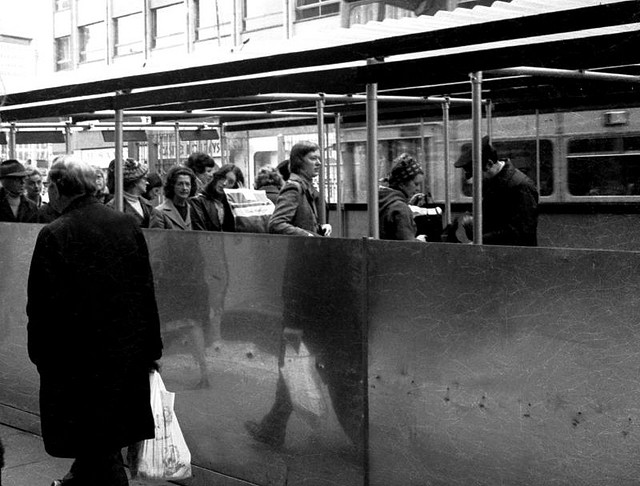
At the same time, due to co-ordinated paramilitary violence against businesses in the city, the infamous ‘ring of steel’ began to take shape around the city core. Beginning with informal military checkpoints on major routes, security measures intensified over the 1980s to the point where citizens who wanted to access central Belfast were made to queue up to pass through turnstyles in ten foot high steel walls, only being granted access once they had been frisked by military personnel. This led to a negation of ownership with regards to the city. The city centre was owned by someone else, be they military or paramilitary.
This removal of people from the city centre has created the cultural vacuum that is Belfast city centre today. The physical conflict has gradually died out since the ceasefires of the early 1990s, causing politicians to hail the success of the ‘peace process.’ The neutrality of the city centre, sterilised so as not to scare off investors, along with the segregation of inner city neighborhoods suggests that the conflict is far from gone.

In Belfast we are proud of our past, particularly with regards to shipbuilding and linen, yet the city centre is totally devoid of any official memorials or markers for the appalling atrocities committed in the past forty years. Oxford Street bus station, a building that became synonymous with ‘Bloody Friday,’ has been scoured from the street and replaced with an office complex. The gruesome descriptions from eyewitnesses on the ground that day are comparable to reports coming out of Kosovo and Syria in recent years. Yet this traumatic event goes unmarked, consisting only of individual memory and official documents.
A culturally empty urban centre is but a small problem, however, when we consider the memorials and plaques outside the city centre; each community choosing to memorialise specific events within their own areas. This causes misremembered and editorialised versions of these events to be passed down the generations, reinforcing the ‘us and them’ tradition. Local urban geographer Peter Shirlow describes this as “The criminilisation of the ‘other’ community and the failure to recognise suffering was endured within both communities...”

What we need is a meaningfully cultural city centre that goes beyond gaudy tourist attractions, glass shopping centres and the halcyon days of linen and shipbuilding and begins to speak of what we’ve been through, confronting us with how awful it was in our day to day civic engagements. This will enable us to move forwards and mark off how far we’ve come.

More than this, it will allow us to reclaim the city before someone else does.